
Open Research & Resources
I make analytical code, teaching materials, and selected research infrastructure public where they can be reused beyond a single study. Stable releases are archived with Zenodo DOIs where appropriate.
Research code
reproducible analysis
HOPESEN: SEND provision and secondary-school outcomes
HOPESEN provides the analytical code for population-based analyses of SEND provision profiles and education and health outcomes among secondary-school pupils in England using the ECHILD Research Database.
It includes linked-data cohort construction, outcome derivation, descriptive analyses, and fixed-effects Poisson regression workflows for the ONS Secure Research Service, while documenting practical reproducibility constraints in an air-gapped trusted research environment.
Source code and documentation · Archived v1.0.0 release and DOI
Teaching and methods resources
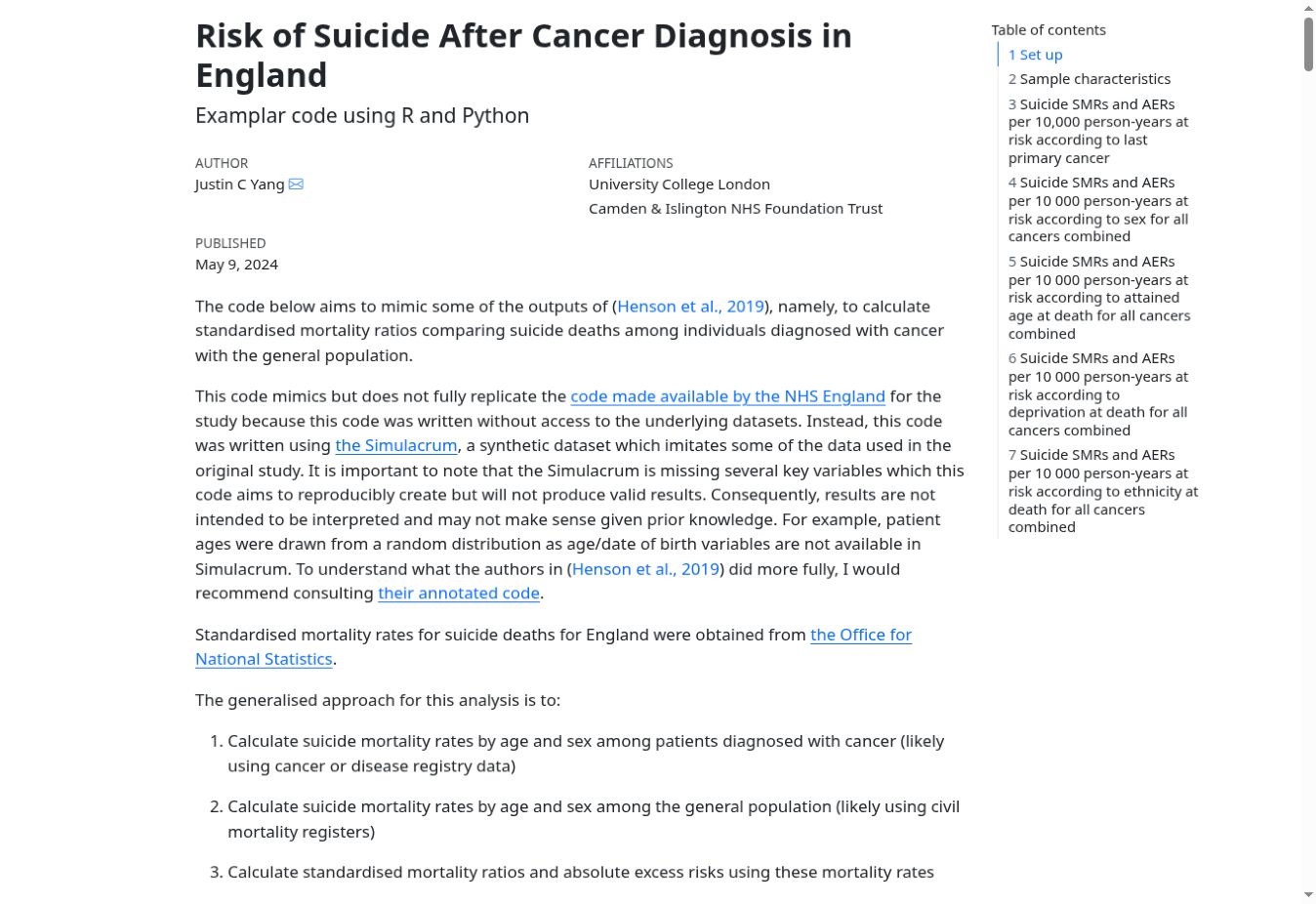
Routine data analysis across R, Python, and Stata
Risk of Suicide After Cancer Diagnosis in England is a worked teaching resource demonstrating approaches to analysing routinely collected health data. It covers survival-analysis workflows, person-time, standardised mortality ratios, and absolute excess risks, with examples in R, Python, and Stata.
The material uses synthetic and published data for methodological and educational purposes. Source code and documentation · Archived v1.0.0 release and DOI
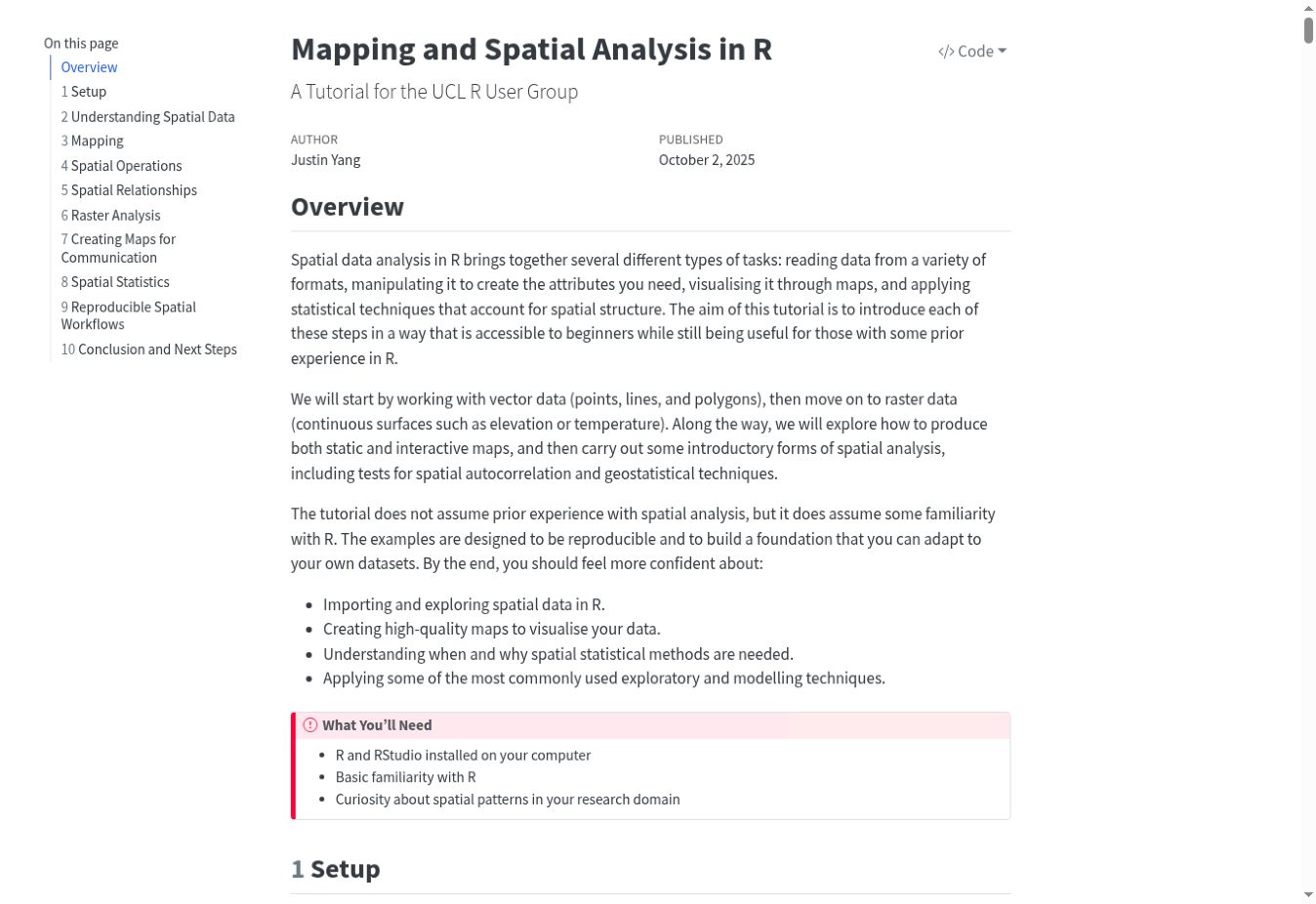
Mapping and spatial analysis in R
Mapping and Spatial Analysis in R is an introductory tutorial developed for the UCL R User Group. It covers spatial data structures, coordinate reference systems, vector and raster analysis, mapping, spatial joins, proximity and adjacency, spatial autocorrelation, hotspot analysis, and introductory spatial interpolation.
The tutorial is designed for researchers and analysts with basic R experience who are new to spatial analysis. Source materials · Archived v1.0.0 release and DOI
Open infrastructure
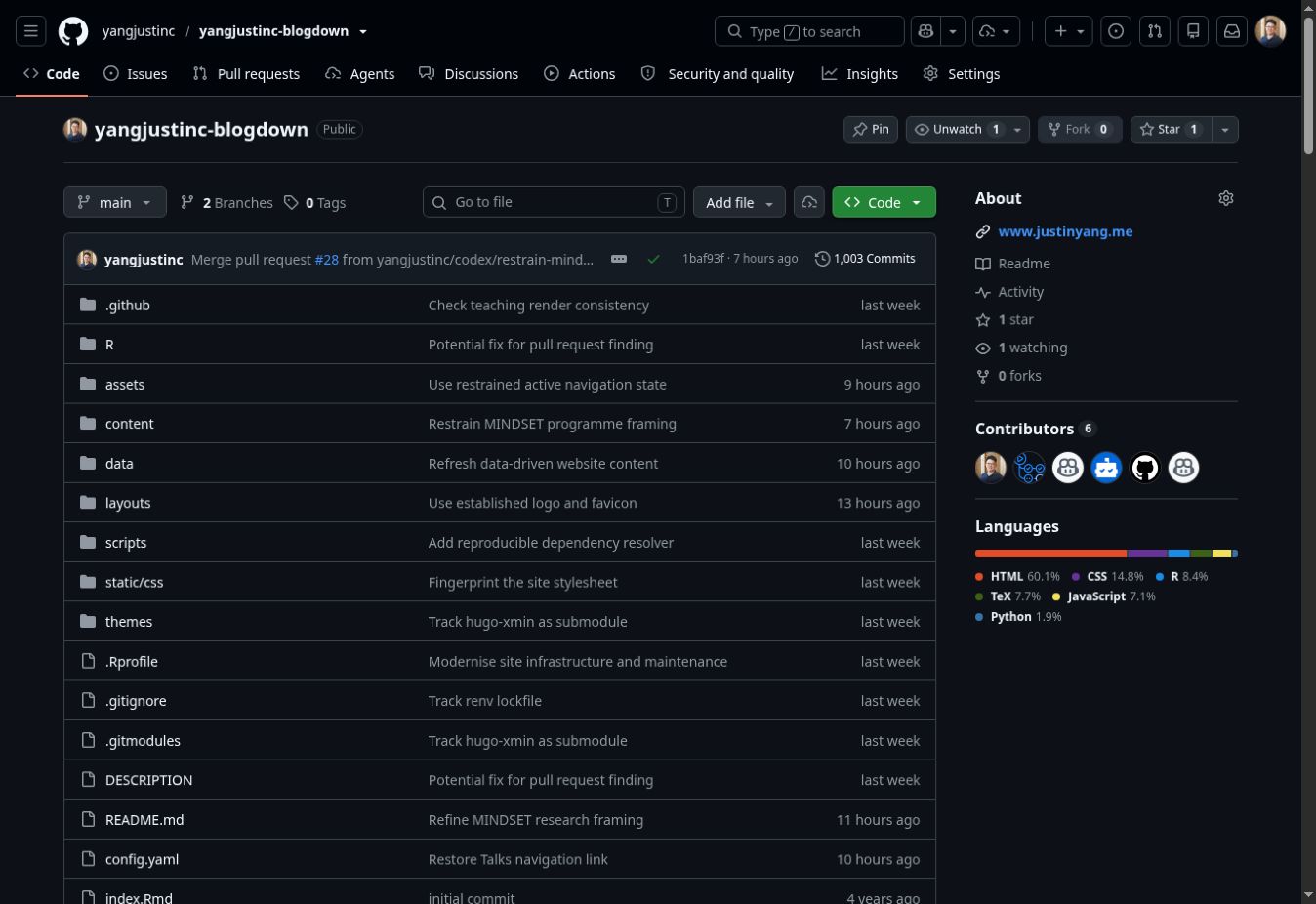
Reproducible website infrastructure
The website source is public. The site uses Hugo, R, ORCID, OpenAlex, Crossref, GitHub Actions, and small curated data files to maintain publications, funding, talks, teaching, and other academic content with limited manual duplication.
The repository documents the build, dependency-management, content-refresh, and validation workflow.
More code, talks, and materials
Additional public repositories are available through my GitHub profile, and selected academic and methods presentations are listed under Talks & Presentations.
Project-specific code and materials are also linked from the relevant research, publication, and teaching pages where available.